Everything Hinges on the Nuclear Fuel Supply Chain
A country’s ability to generate dependable power is inseparable from its economic resilience, technological leadership, and defense readiness. In short, energy security is national security.
Nuclear is a prime example of dependable power. It delivers reliable, around-the-clock energy with a small physical footprint, without depending on vulnerable fuel-delivery networks. For data centers, military operations, industrial facilities, and other critical infrastructure that cannot afford to go offline, that consistency matters. For nearly 50 years, the country deprioritized in nuclear energy and the infrastructure needed to support it. Now it’s ready to accelerate progress, and there’s real opportunity for the companies working to make that happen.
Why nuclear, and why now
The last wave of clean-energy investment was largely propelled by long-term emissions targets and corporate sustainability commitments. Those factors remain important, but the current demand for energy is less of a “nice-to-have” and more of a “must-have.”
Nuclear demand has moved from theoretical to immediate, and AI is the driving factor. Hyperscalers need massive amounts of energy to power their data centers 24/7. Nuclear is the constant energy source that these data centers need, as they are estimated to consume up to 12% of all U.S. energy production in 2028. AI has played a critical role in pushing the U.S. into this present “nuclear renaissance.”
At the same time, the public and private sectors are increasingly aligned when it comes to nuclear power. Nuclear energy has bipartisan support, while hyperscalers, utilities, industrial companies, and federal agencies are committing capital and resources to new projects. In May 2025, the administration issued a series of executive orders aimed at accelerating reactor testing, reforming licensing, deploying advanced reactors for national-security uses, and rebuilding the domestic nuclear industrial base.
This rapid pace of progress was evident when we visited Idaho National Laboratory (INL) at the beginning of the year. INL is the lead nuclear energy research facility in the country and a central testing ground for advanced reactors. Since that visit, our portfolio company Antares achieved initial criticality for its Mark-0 microreactor at INL, becoming the first private company to bring an advanced reactor to criticality through the Department of Energy’s Reactor Pilot Program. This milestone reinforced what we saw firsthand at INL: Advanced nuclear is moving beyond research and planning and into testing, validation, and execution. The industry is too far forward to go back.
The nuclear fuel cycle
The fuel cycle begins with mining and milling uranium into a concentrated powder called yellowcake. That concentrate is converted into uranium hexafluoride gas, which is then enriched to raise the concentration of the fissile isotope uranium-235 until the material can sustain the reactions required by a given reactor design. The enriched uranium is finally fabricated into fuel: pellets loaded into rods and bundled into the assemblies a reactor runs on.
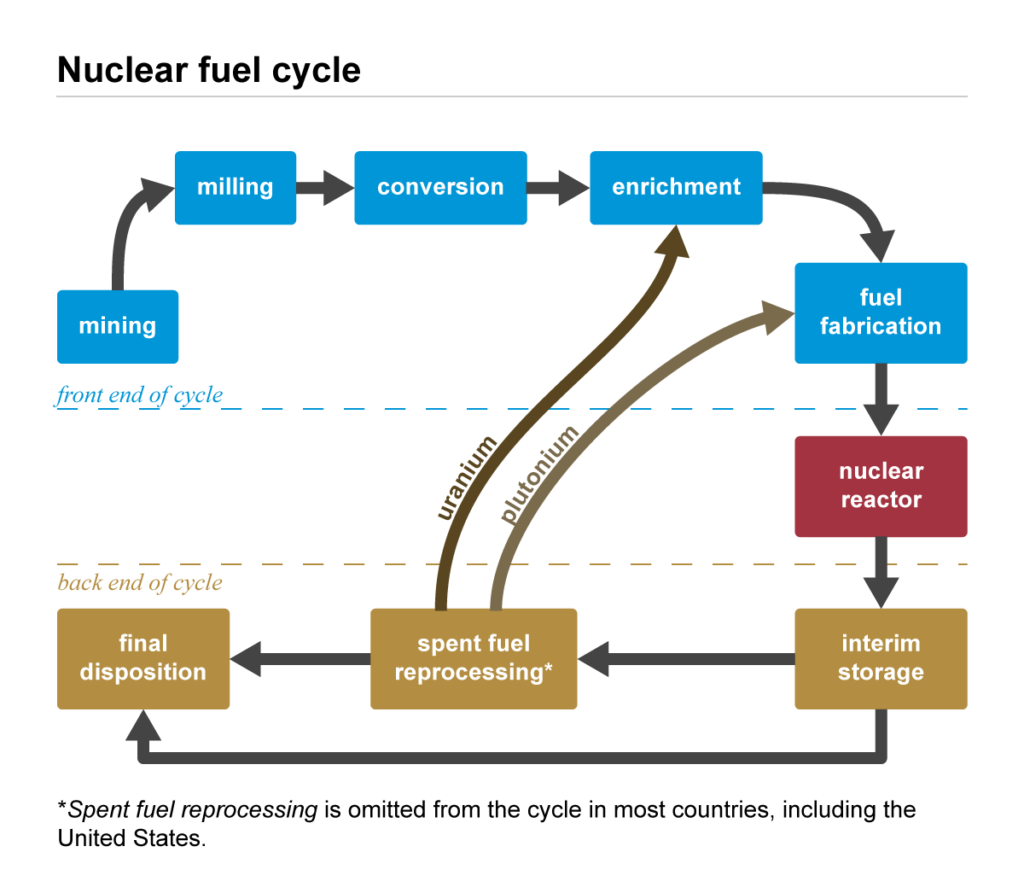
The U.S. mines uranium domestically and buys it from allied suppliers. The bottlenecks sit in the middle of the cycle—conversion and enrichment—where domestic capacity is thin and the country depends on imports, including a meaningful share from adversaries, to fill the gap. The Department of Energy estimates the U.S. imports 20% to 25% of its enriched uranium from Russia. Congress has since prohibited Russian low-enriched uranium imports with the broader ban extending through 2040. This policy only makes the need to scale domestic capacity more urgent.
The United States is developing a new generation of advanced and small modular reactors without yet having a sufficiently scaled, domestically controlled “gas station” to fuel all of them. This lack of infrastructure isn’t because the U.S. is incapable of developing or funding it. Rather, the U.S. didn’t anticipate this “nuclear renaissance” and how important nuclear power would become as an energy source.
Fuel is a national-security issue as much as it is an energy issue. Domestic reactors cannot provide true energy independence if their most critical inputs remain dependent on adversarial supply chains.
Where we see investment opportunity
Our investment in Antares brought us directly into the advanced nuclear ecosystem last year. Now, we are proud to return as investors in their $470M Series C and continue backing Jordan Bramble and the team as they build on the immense momentum they have generated since reaching criticality.
Reactors like the ones Antares is building are the more visible part of the market, and where most attention and capital have flowed. Equally critical is the fuel chain around them, most of which doesn’t yet exist under domestic control at commercial scale. On the front end, that’s the path from mined uranium to reactor-ready fuel: conversion, enrichment, and fabrication. On the back end, it’s closing the loop: storage, reprocessing, and waste management. Fuel supply is the pick-and-shovel layer beneath every reactor, with demand that compounds as deployment scales, largely independent of which designs win. These are the persistent constraints on a scaled, secure U.S. nuclear industry, and the companies solving them are where we’re spending our time.
What comes next
As the nuclear market moves toward scaled deployment, the need to rebuild the infrastructure around it is becoming increasingly urgent. AI infrastructure, defense systems, and grid constraints are all increasing the value of continuous, secure power.
The path forward won’t be simple. Nuclear remains a highly technical, regulated, and capital-intensive industry. Public confidence is also essential. Any safety failure could slow progress across the entire market, which is why the companies that succeed will be those that treat safety, quality, and regulatory rigor as core product requirements rather than administrative burdens.
We plan to continue spending time with the founders, operators, national laboratories, government leaders, and industry partners rebuilding the ecosystem. Our focus will remain on the companies addressing its most persistent constraints and creating the infrastructure for a more resilient nuclear future.