Prior Authorization Serenity Now?
On Seinfeld, Frank Costanza would yell “Serenity Now!” when his blood pressure rose. For clinicians dealing with prior authorization (PA), the feeling is all too familiar. New companies are now applying AI to solve the nagging issue of PA. The question is whether AI can truly reduce the burden of PA, and if so, how close are we to achieving a little serenity in the process?
Prior Authorization at a Glance
Prior authorization grew out of early utilization review programs in the 1950s, 60s, and 70s that were designed to ensure appropriate medical spending and control spiraling costs. (Source). PA requires a provider to request approval from the patient’s insurance before delivering certain treatments or prescribing specific medications.
Typically, a PA is reserved for high-cost or high-risk of abuse medications and procedures, but today, numerous procedures and treatments call for PAs (Source). Providers gather information from the patient and the medical record, then fill out a form, which is submitted to the insurer. Insurance companies have systems and teams reviewing these PAs for relevance and medical appropriateness before issuing an approval or denial.
At 53 Stations, we are focused on helping fix the friction in healthcare, and prior authorization is one of the most significant sources of it. Providers report spending an average of 13 hours a week on prior authorizations, with 40% of physicians employing staff dedicated solely to PA. (Source). Nearly 30% say delays and administrative burden have led to a serious adverse event for a patient, and more than 90% report PA has delayed care (Source). The human cost, in many cases, is impossible to measure.
Legacy Prior Authorization Solutions
For years, prior authorizations were compiled manually and submitted to payers via fax. Companies like CoverMyMeds, Surescripts, and Availity in the late aughts and early 2010s began digitizing this process, creating electronic prior authorizations (ePAs). These companies created portals that connected payers and providers to allow for the submission of PAs and supporting materials. Payers can communicate a response to providers through these portals as well. Electronic PAs through portals or other channels are increasingly the primary way PAs are submitted (below).
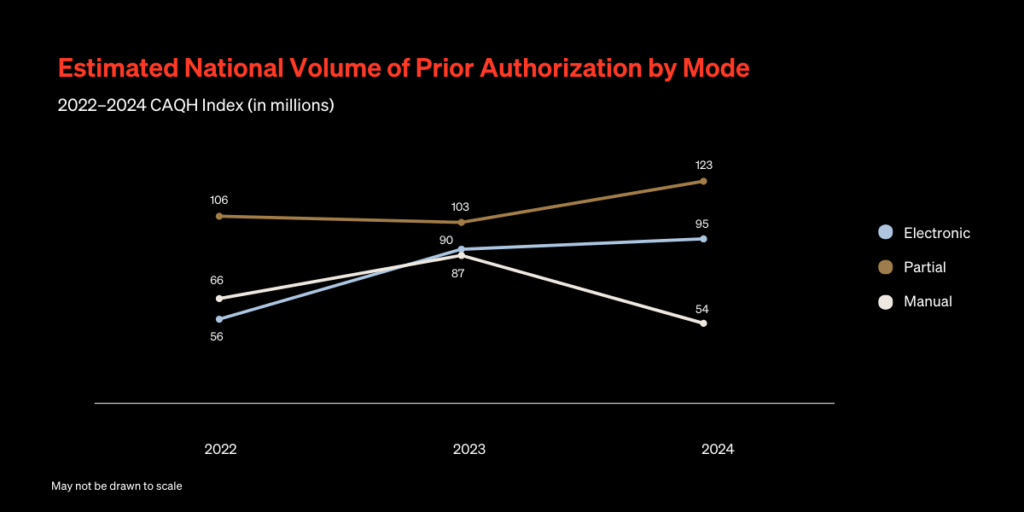
While ePAs marked progress, points of substantial friction still remain. First, providers need to understand which portal to use for which patient, given different insurers have different portals. Second, providers need to understand the payer’s criteria to approve a PA. This criteria may be delivered electronically in portals, but in some instances, providers need to call payers to get this information. From there, clinicians need to gather the required clinical documentation to complete the PA. This involves reviewing the patient’s chart and appending relevant data from the chart into the PA request.
Novel AI Prior Authorization Solutions
This is where AI steps in. With the ability to parse unstructured data and automate repetitive tasks, AI can eliminate much of the remaining friction. LLMs can scrape payer PA requirements from portals and clearinghouses, summarizing the criteria a patient needs to meet for PA approval. AI can be used to directly submit a PA to these portals, automating the submission process (Source).
Companies like Silna use AI to extract information from supporting medical documents to pre-populate PA requests and, therefore, eliminate the need to manually review a patient’s chart. Other companies, like Infinitus, are using voice AI tools to call payers to confirm the need for prior authorization, gather payer rules, and check the status of the prior authorization.
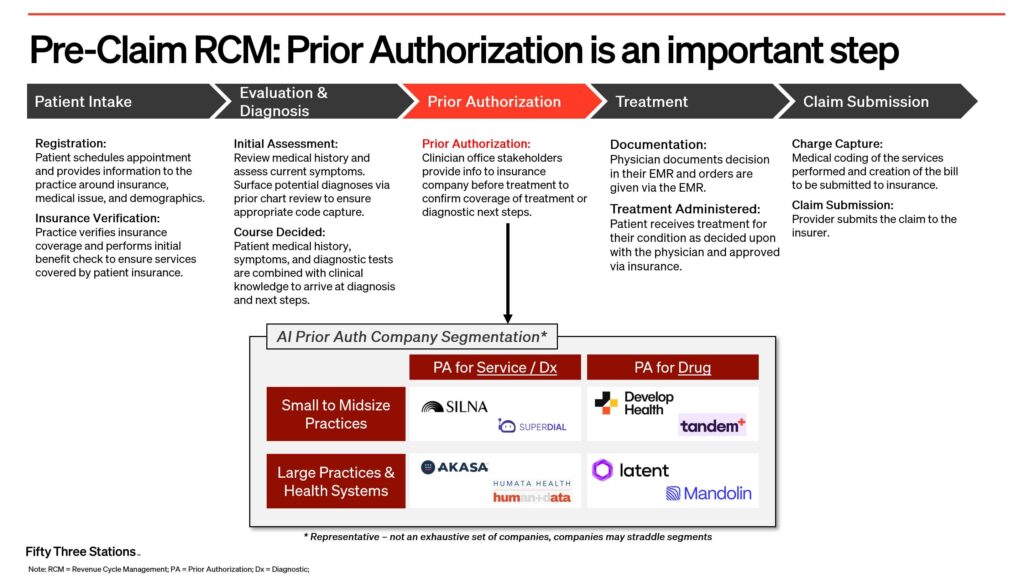
The AI PA vendor market appears to be segmenting by organization size, specialty, and objective of PA (e.g., procedure or prescription). For instance, Silna and SuperDial leverage AI to automate the PA focusing on procedure-based specialties, like physical therapy and dental, for small to mid-sized practices. In contrast, a company like Latent spans multiple specialties, supporting large hospital systems while focusing on drug prior authorizations.
Recent Macro Momentum
Against this backdrop of innovation, government and payer actions may impact the overall market. Recently, the government released the WISeR model, which requires prior authorization for certain Medicare services, with submissions allowed via Medicare Administrative Contractors or approved vendors. CMS-0057-F mandates that payers return PA decisions within 72 hours, provide APIs for PA submissions, and clearly explain denials (Source). Together, these regulations create tailwinds for PA technology companies
Payers themselves are also pledging reform. Nearly 50 payer organizations have committed to standardizing the ePA, reducing the scope of claims subject to PA, and expanding real-time responses, among other commitments (Source). These changes will make it easier for providers and their technology solutions to navigate the process. Additionally, payers have committed to reducing the scope of claims subject to PA, potentially reducing the value of these PA-focused companies – at least those supporting bread-and-butter submissions and navigation. Despite these payer commitments, provider organizations are suspect that these changes will occur (Source).
The largest potential headwind for PA companies is the rise of gold carding. Insurers like UnitedHealthcare and Humana have committed to reducing the prior authorization burden for providers who consistently have a high prior authorization approval rate (Source 1, 2). For providers that meet the criteria for this elevated, ‘stamp of approval’ status, their PA administrative burden falls as they only need to follow a simple notification process for eligible procedures. A reduced PA burden may reduce the need to hire PA companies.
What We Look For
Despite potential headwinds, tailwinds abound. Costly biologics continue to drive drug pipelines, government mandates are accelerating tech adoption, and providers are already embracing AI tools such as AI scribes. In fact, Abridge, best known for its scribe technology, has expanded into prior authorization to support near real-time submissions.
When evaluating companies in the PA space, we look for those that:
- Balance deterministic and probabilistic approaches: Probabilistic tools (e.g., AI models) can summarize, extract insights, and handle ambiguity, but some workflows call for deterministic solutions (e.g., more traditional tools where the same output is generated for the same input every time). Knowing how to balance these modalities helps with speed, cost, and accuracy.
- Monitor edge cases: Edge cases are a hallmark of healthcare, so building a system to identify and learn from edge cases allows for greater accuracy.
- Demonstrate ROI: Companies need to show they are making a tangible change to the business by eliminating costs, improving patient outcomes, or speeding the PA process.
- Minimize churn: AI has reduced the barrier to building great products, so customers have a choice. Being a sticky solution via workflow integration and value delivery is more important than ever.
- Think of a second act: PA is a great wedge product, but what are the plans to deepen into the workflow or monetize via external parties, like life science companies.
At the end of the day, prior authorization isn’t just a paperwork problem. It shapes how quickly patients receive care and how much time providers spend with them, rather than chasing approvals. The companies pushing the boundaries today are making real progress toward a system that works better for everyone. We are excited by the innovation in the PA space because new companies are truly reducing the friction for providers. We may be getting closer to PA serenity now.