Getting to Know the CFO: A Conversation with The Pritzker Organization Portfolio
The CFO role has quietly become one of the most expansive—and most pressured—seats in the building. Beyond finance, today’s CFO often owns IT, HR, benefits, procurement, legal, and risk. They’re being asked to do more with less, integrate AI before the playbook exists, and manage complexity that legacy systems weren’t built for.
We wanted to hear it directly from operators. And through The Pritzker Organization (TPO) portfolio, we have unique access to the financial executives running complex businesses across fiber infrastructure, construction, industrials, and more. Last month, we brought together a group of CFOs from across the TPO portfolio for a candid conversation about what’s real, what’s broken, and where innovation could actually help.
We were joined by CFOs and other finance leaders from STV, Sun Day Carwash, Clearwave Fiber, Lithko Contracting, Kettle & Fire, TPO, US Laundry, TMS International, and ADL Final Miles. Here’s what we heard.
The CFO role has expanded well beyond finance
We opened by asking the executives to describe their full remit. Across the group, that list extended into IT, business intelligence, warehouse management, business development, real estate investments, and insurance. At a large scale industrial business, the finance team oversees IT alongside core finance functions. One executive described how his team manages insurance complexity and customized reporting for a broad cap table. Another CFO meanwhile, is running finance for a business that went from startup to $2 billion in revenue and 7,000 employees in eight years, and getting the right information to the right roles at that velocity is its own full-time problem.
The CFO, across this group, is operating as a strategic command center, not a back-office function. After the session, we followed up with a short survey. Half of respondents confirmed an expanded remit over the past few years. The two who said their direct span narrowed clarified that it reflected hiring specialists, not reduced responsibility. The complexity keeps growing either way.
Systems fragmentation is a persistent, shared problem
The frustration that surfaced most consistently was not about any single tool. It was about the effort required to get data out of one system and into another, or simply to hold a coherent view across organizations built through acquisition. Simply put, systems fragmentation. One CFO is currently consolidating across seven operating systems inherited from acquisitions. Another is actively reconciling disparate legacy systems while exploring AI automation. And another described the challenge of managing a spin-out merger while trying to rationalize processes before touching systems, noting that the sequencing matters as much as the tooling does.
The survey put numbers to it. Most of these CFOs are managing six to ten finance software vendors, and five of six said that count has gone up. The majority of respondents also spend at least five hours a week reconciling data. One CFO spends more than twenty.
The tools that are actually working
For a group of CFOs managing lean teams across complex operations, the combination of reduced manual work and reliable integrations is what tends to drive adoption of new tech. One tool came up repeatedly: Ramp. The executives cited its app-driven expense management, text-based receipt capture, clean ERP integration, and automated approval workflows as reasons they have moved or are actively moving AP workflows onto the platform.
The value of other tools was still being determined. One executive found the adoption and effectiveness of Microsoft Copilot to be limited because the company’s data wasn’t in one singular place. Now, they’re migrating to Microsoft OneDrive so that Copilot will be able to handle routine monthly variance analysis across departments. Another in the group has Trunk Tools deployed across operations teams. It works well on the job site, allowing workers to ask technical questions and pulling answers from the company’s proprietary data, as well as industry standards. The jury is still out on ROI.
Knowing what tools work well for CFOs allows us to track companies that will provide real operational value to these teams—like Flex, an AI-native platform that manages all transactions, both business and personal.
The data layer comes before the AI layer
Several executives noted that their current focus is optimization of what they already have, not wholesale replacement. One team has layered a business intelligence platform on top of systems inherited through acquisition, using common nomenclature to create a unified view across entities that previously had no shared data language. AI tooling for automated insights is being added on top of that foundation, and the organization runs weekly cross-functional meetings to prevent fragmented adoption from taking hold across departments.
At other portfolio companies, the priority is consolidating data sources before deploying AI at all, rather than enabling AI on top of fragmented infrastructure and expecting clean outputs. Tooling alone does not resolve the underlying data architecture problem.
Bringing these learnings back
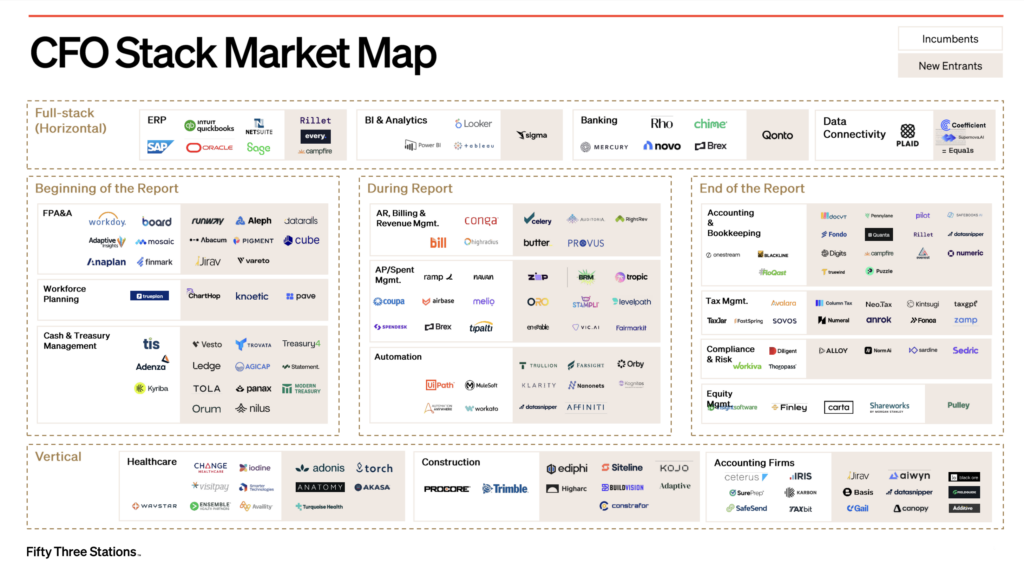
The more we understand what CFOs are actually navigating day to day, the better we can identify the right tools and bring them into the portfolio. When evaluating new technology, cost and ROI are nearly universal criteria for this group, and implementation burden is a real barrier. The best tool doesn’t win if the switching cost is too high. That’s the lens we’re bringing to this work. We’re grateful to the executives who joined and plan to keep these conversations going.
To stay in the loop on future sessions and events, subscribe to our newsletter.