Five Takeaways from Asembia 2026
Lynn Kha, MBA fellow on the 53 Stations healthcare team, attended Asembia’s AXS26 Summit, the industry’s largest specialty pharmacy conference, to pressure-test the firm’s healthcare sourcing against the pain points manufacturers, payers, HUBs, and specialty pharmacies are facing.
At 53 Stations, the team is excited about AI-enabled coordination of broken workflows. This aggregation is particularly important across payer-provider operations, pharma industry, and the specialty drug ecosystem, where GLP-1s and wave of cell and gene therapies are exposing outdated infrastructure. The drugs are expensive, the workflows are fragmented, the patient experience is broken, and every stakeholder is racing to figure out where AI fits.
Now, specialty pharmacy is shifting from a dispensing function to coordination. The most durable companies will not be the ones that automate a single task in isolation. Instead, they will be the organizations that coordinate the entire patient journey, resolve coverage and access barriers at the point of prescribing rather than after the visit, and support patients around their disease rather than a specific drug brand. Read on for our key takeaways from Asembia.
1. AI is graduating from automation to orchestration
While 69% of healthcare and life sciences executives now consider AI a top strategic priority in 2026,1 only 8.3% of healthcare enterprises have AI deployed in production today.2 Healthcare is still in the early innings because its workflows are high-risk and heavily regulated, requiring AI systems to meet a high bar for governance, consistency, and trust before they can be deployed at scale.
The current specialty pharmacy system is seen as transactional, with patients forced to re-explain themselves across disconnected stakeholders. AI orchestration was positioned as the path to a more continuous, personalized experience, and the bigger shift on display was the move from isolated AI use cases toward full-journey orchestration. CVS Specialty walked through a live version of this, showing an orchestration layer that unifies digital, phone, IVR, and chat into a single continuous experience. If a patient starts a process digitally and later calls a representative, the system preserves the full context so the patient does not have to repeat themselves. That kind of continuity came up repeatedly throughout the conference.
Rather than automating individual tasks like prior authorization, benefits verification, coverage checks, or patient education in isolation, organizations are starting to use AI to coordinate the full patient access journey end-to-end. The future state is less about automating subprocesses and more about orchestrating entire workflows from prior authorization through therapy initiation and ongoing support. Agent-to-agent interoperability also drew significant attention, where multiple AI agents across different systems coordinate with one another behind the scenes to create what feels like a single unified experience for the patient.
2. Access is moving “inside the workflow”
Today’s specialty access process works as a handoff. A physician writes a specialty prescription and routes it to a HUB, typically a manufacturer-funded third-party program. The HUB becomes responsible for the next steps, including benefits verification, prior authorization, copay assistance enrollment, and coordination with a specialty pharmacy. The patient is handed a phone number and told to expect a call. This process happens after the visit, outside the EHR, and after the patient is actually engaged. Unfortunately, the model leaks at every step. Patients miss calls, get confused about who’s reaching out, and disengage before coverage is even resolved.
“Inside the workflow” pulls all of that work into the Electronic Health Record (EHR) while the patient is still in the room with their physician. Benefits verification, prior authorization, copay enrollment, and pharmacy routing happen in real time as part of the prescribing decision. The patient leaves already enrolled, covered, routed, and informed. Capturing the HIPAA-required consent in the exam room is also far more effective than chasing it by phone days later. Additionally, brand-specific HUBs are likely to lose market share to disease-area orchestration platforms that sit inside EHRs and serve many brands at once. Patients organize their lives around their condition, not around a manufacturer’s brand. They want one coordinated experience, regardless of which company makes the drug they’re on.
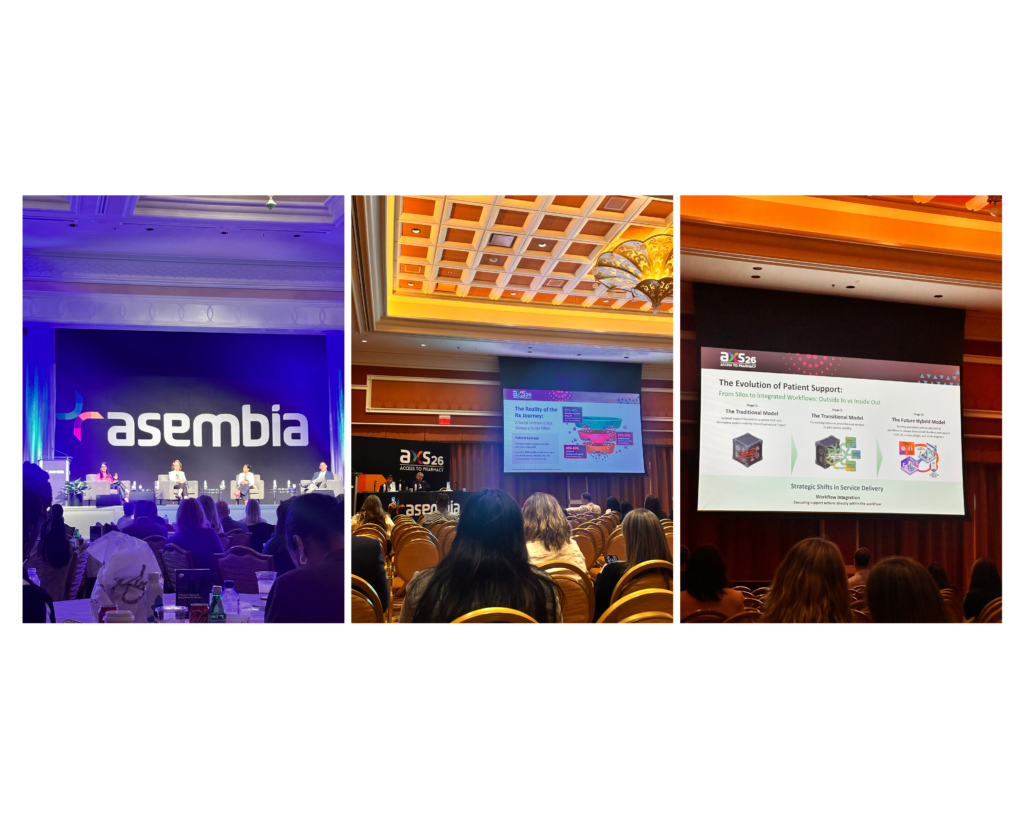
3. Friction, not innovation, is the bottleneck
Most manufacturers cannot answer basic questions about their own products with confidence. How many scripts actually get dispensed? Where do patients fall out of the process? The visibility is not there, and that absence is the defining operational problem in specialty today.
Prior authorization is still slow and inconsistent. Coverage rules grow more complex every plan year. Patients face fragmented navigation across payers, pharmacies, and providers. Prescribers face mounting administrative burden that pulls time away from clinical care. None of these problems are new, but in aggregate they have become the biggest barrier to whether a therapy actually reaches a patient.
4. Advanced therapies are exposing infrastructure gaps
Cell and gene therapies are the clearest example of science outpacing the system built to deliver it. Price points already range from roughly $300K to over $4M per treatment,3 storage and logistics have near-zero tolerance for error, and patient volumes are expected to rise significantly as advanced therapies expand beyond oncology into autoimmune disease, hematology, and broader rare disease categories.
Patients today often must travel long distances to academic medical centers, temporarily relocate, coordinate care across multiple providers, and navigate fragmented reimbursement pathways simply to access treatment. One case study described a patient who remained delayed for more than 14 months despite being clinically approved for gene therapy3 due to coordination failures, supply disruptions, and payer complexity. Another showed how payer redirection between treatment centers disrupted planned CAR-T therapy altogether.
Delivering advanced therapies at scale will require stronger coordination between community oncology and academic centers, broader provider networks, predictable authorization pathways, specialized navigation support, and new infrastructure layers across specialty pharmacy, providers, and manufacturers. As these therapies move into larger patient populations and more decentralized care settings, the coordination burden will only grow.
5. Rare disease is getting competitive, fast
Rare disease used to mean little to no therapeutic competition. That assumption is no longer accurate. The number of rare diseases with more than two approved therapies grew from 16 in 2015 to 101 in 2025,4 and the curve is steepening. As competition increases, payer behavior shifts. Stricter prior authorization requirements, step therapy rules that require patients to try other treatments first, and tougher utilization management controls are now showing up in categories that previously had few coverage restrictions.
For manufacturers, that means clinical differentiation alone is no longer enough. Operational and patient-experience differentiation is becoming the second axis of competition. And the patients themselves are clear about what they want, which is a single point of coordination. Rare disease patients today often self-coordinate their care, wait long periods between updates, navigate multiple disconnected stakeholders, and endure years of misdiagnosis before they ever reach therapy. Whoever solves that coordination problem at the disease level, and at the patient level rather than the brand level, will capture disproportionate value.
Takeaway for 53 Stations
Asembia sharpened conviction in prior authorization and care coordination, areas the firm is already tracking. It also highlighted a broader opportunity around the infrastructure that helps patients access, start, and stay on therapy. That includes AI-powered orchestration platforms, workflow-integrated access solutions, and the operational infrastructure needed to deliver increasingly complex therapies at scale. Together, these technologies improve both the patient and provider experience.
Companies defining this shift share a few traits. They are present at the point where the patient is prescribed treatment, rather than picking up the patient after the fact. They serve multiple brands and multiple stakeholders rather than being tied to a single manufacturer. Lastly, they collect data on how patients move through coverage, prescription, and adherence across many drugs and payers, which becomes harder for any single-brand competitor to replicate over time. If you’re a founder building in any of these areas, we’d love to hear from you!

Sources
1 NVIDIA. State of AI in Healthcare and Life Sciences: 2026 Trends. Survey Report. January 2026. https://www.nvidia.com/content/dam/en-zz/Solutions/lp/survey-report/healthcare-state-of-ai-report-2026-4559650-web.pdf
2 Nguyen TD, Whaley CM, Simon K, et al. Adoption of Artificial Intelligence in the Health Care Sector. JAMA Health Forum. 2025;6(11):e255029. doi:10.1001/jamahealthforum.2025.5029. https://jamanetwork.com/journals/jama-health-forum/fullarticle/2841460
3 Gregory F, Denny L, Marjon P. “The Evolution of Advanced Therapies: How Specialty Pharmacies and Community Providers Are Improving Access to Patient Care.” Presented at Asembia Specialty Pharmacy Summit (AXS26); April 29, 2026.
4 Black J. “Trends in US Payer Management of Competitive Rare Diseases.” Presented at Asembia Specialty Pharmacy Summit (AXS26); April 29, 2026.