Building Beyond at NY Tech Week
Today’s technologies – AI, data centers, electrification, automation – aren’t just shifting how we live and work. They’re redrawing the demands we place on the built world. And those demands are arriving faster than our physical systems were designed to absorb.
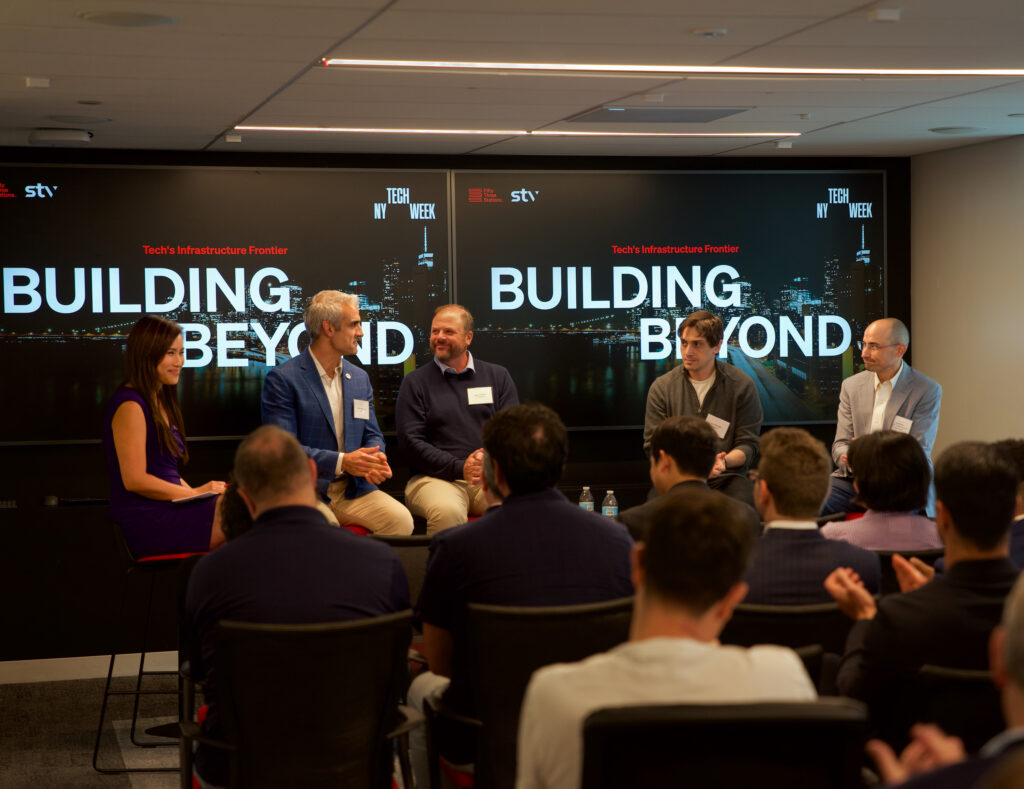
At New York Tech Week, 53 Stations and global infrastructure leader STV co-hosted a panel and networking event for founders, operators, and investors across contech, energy, supply chain, and RE:tech. Held in the iconic Empire State Building, the conversation centered on a shared challenge: how to plan, build, and deliver infrastructure in an era of exponential technological change.
Moderated by Lynda Tran, former senior advisor to the U.S. Secretary of Transportation and current board member at STV, the panel featured:
- Garo Hovnanian, Executive Vice President of Advisory Services at STV
- Jason Pritzker, Managing Director at 53 Stations and Vice Chairman of The Pritzker Organization
- Vinn White, former Chief AI Officer and Senior Advisor for Innovation at the U.S. Department of Transportation
- Nicholas Selz, Co-founder & President of Kaya AI
Panelists offered sharp perspectives on the physical systems underpinning our most ambitious technologies – not as a simply a policy problem or funding gap, but as a delivery challenge. Here are the key takeaways from the conversation.
Bringing Systems Thinking to Frontier Tech
Frontier technologies, from AI to electric vehicles to autonomous systems, don’t just need new tools. They require new infrastructure ecosystems. AI alone is forcing massive shifts in power demand, data movement, and cooling requirements. EVs and autonomy ask different questions about roads, safety, grid load, and materials sourcing.
None of this is speculative. The first-order effects are already here. What we’re just beginning to understand are the second-order consequences – the strains that emerge when innovation scales faster than the systems that support it.
“We’re seeing exponential change collide with linear systems,” observed Selz. That tension defines this moment.
Hovnanian emphasized the importance of holistic planning: “There’s only so many data centers and semiconductor facilities that need to happen. Outside of all of that is water infrastructure, power infrastructure, roads, and social infrastructure. You can’t bypass great planning. The decisions you make today last for 50 years.”
The Labor Crisis Driving Innovation
The most pressing challenge isn’t just about new infrastructure—it’s about who’s going to build it. The construction industry faces massive labor shortages across all trades, with 50% of the workforce set to retire in the next decade. “We need to think about AI and technology as enabling forces that help people be more efficient and get the most out of them.” said Pritzker.
Selz highlighted a staggering statistic: “75% of the infrastructure the world is going to need by 2050 hasn’t actually been built yet.” Costing examples such as fires in Southern California, floods in North Carolina, and Indonesia “literally building an entirely new capital city because Jakarta is sinking”, the scale of construction needed is mind-boggling – yet there aren’t enough people to build what’s already on the ground today.
The solution lies in supporting workers with technology, not replacing them. The next generation of construction leaders are digital natives who are actively seeking tech solutions to streamline their operations.
Rebuilding Confidence in Delivery
Even with capital flowing into climate tech, automation, and next-gen infrastructure, confidence in delivery remains fragile. Timelines slip. Supply chains buckle. Project costs swell, and stakeholders lose conviction.
This crisis of confidence affects everyone from startups to institutional investors to public agencies. The core challenge isn’t a lack of ambition, but a lack of clarity around execution.
Selz shared how supply chain intelligence can address this challenge: “Anywhere between 40 to 50% of construction project delays are due to issues with the supply chain.” With lead times for critical equipment like generators, transformers, and chillers stretching longer than ever, real-time visibility becomes crucial.
“You’re trying to get a certain set of materials to a set of latitude and longitude coordinates at a very precise moment in time,” Selz explained. “There’s immense complexity in the simplicity of that challenge.”
Kaya AI’s approach involves ingesting structured and unstructured supply chain data to provide project teams with actionable intelligence – alerting them when submittals need approval, materials need release, or manufacturing partners need follow-up to prevent schedule delays.
Redesigning Public-Private Partnerships at the Pace of Change
Public-private partnerships aren’t new, but most weren’t designed for the pace or complexity of today’s infrastructure challenges. Innovation is moving faster than traditional contracting models can keep up with – exposing the limits of old frameworks.
White shared insights from his time as the DOT’s first Chief AI Officer: “Secretary Pete (Buttigieg) had a point of view that this is very much like the early days of the internet. I’m not going to have an assistant secretary for internet,’ but what I need is for everybody to understand what its capabilities are, how we can use it as a tool, how it can impact us.”
The federal workforce is experiencing unprecedented turnover, with 9% of DOT employees recently taking early retirement options. This creates both challenges and opportunities – forcing greater reliance on technology to maintain functionality while opening space for new approaches.
“Partnership isn’t enough if no one owns the outcome,” noted White. “What’s needed is shared accountability – where every player has both a role and a stake in what gets built.”
The Technology Adoption Bridge
The construction industry’s reputation for being slow to adopt new technologies is beginning to change, driven by necessity and a new generation of leaders. However, adoption remains uneven.
At the enterprise level, companies like Turner Construction have direct partnerships with OpenAI and are investing heavily in data-driven solutions. Meanwhile, smaller contractors are finding value in technologies that automate back-office functions and streamline communications.
“You don’t have to have gone through all the hard steps for 20 years in order to learn,” Hovnanian observed about the changing workforce. “Information has been so dramatically democratized that people are okay with that.”
The key is creating bridges that allow organizations to “dip their toes in the pool without needing to jump into the deep end.” Successful technology adoption requires meeting customers where they are and building business cases through pilot projects.
The Future of Infrastructure Delivery
Several emerging trends are reshaping how infrastructure gets planned and built:
Procurement-Led Design: Instead of designing in a vacuum, architects and engineers are gaining real-time visibility into supply chain availability and lead times, allowing them to specify materials with greater confidence in delivery timelines.
Agile Portfolio Planning: Large-scale developers are booking manufacturing slots far in advance across their project portfolios, then dynamically allocating materials as schedules progress – similar to agile planning methodologies in software development.
Digital Twin Integration: The future involves connecting supply chain intelligence directly to 4D models, allowing project teams to understand manufacturer details, factory locations, and delivery track records for every component – both during construction and throughout the asset’s operational life.
Building What’s Possible Today
The conversation revealed a construction industry in transition – facing unprecedented challenges but also unprecedented opportunities. The convergence of labor shortages, supply chain complexity, and technological capability is creating space for new approaches to emerge.
Success requires more than just deploying new tools. It demands rethinking how we plan, partner, and deliver at every level, from individual projects to national infrastructure strategies. The companies and agencies that thrive will be those that embrace agile mindsets, invest in their people, and build confidence through demonstrated delivery.
As the built world races to keep pace with technological change, the question isn’t whether transformation will happen. It’s who will lead it.